
How much did Google searches for homes fall in 2026?
Contents
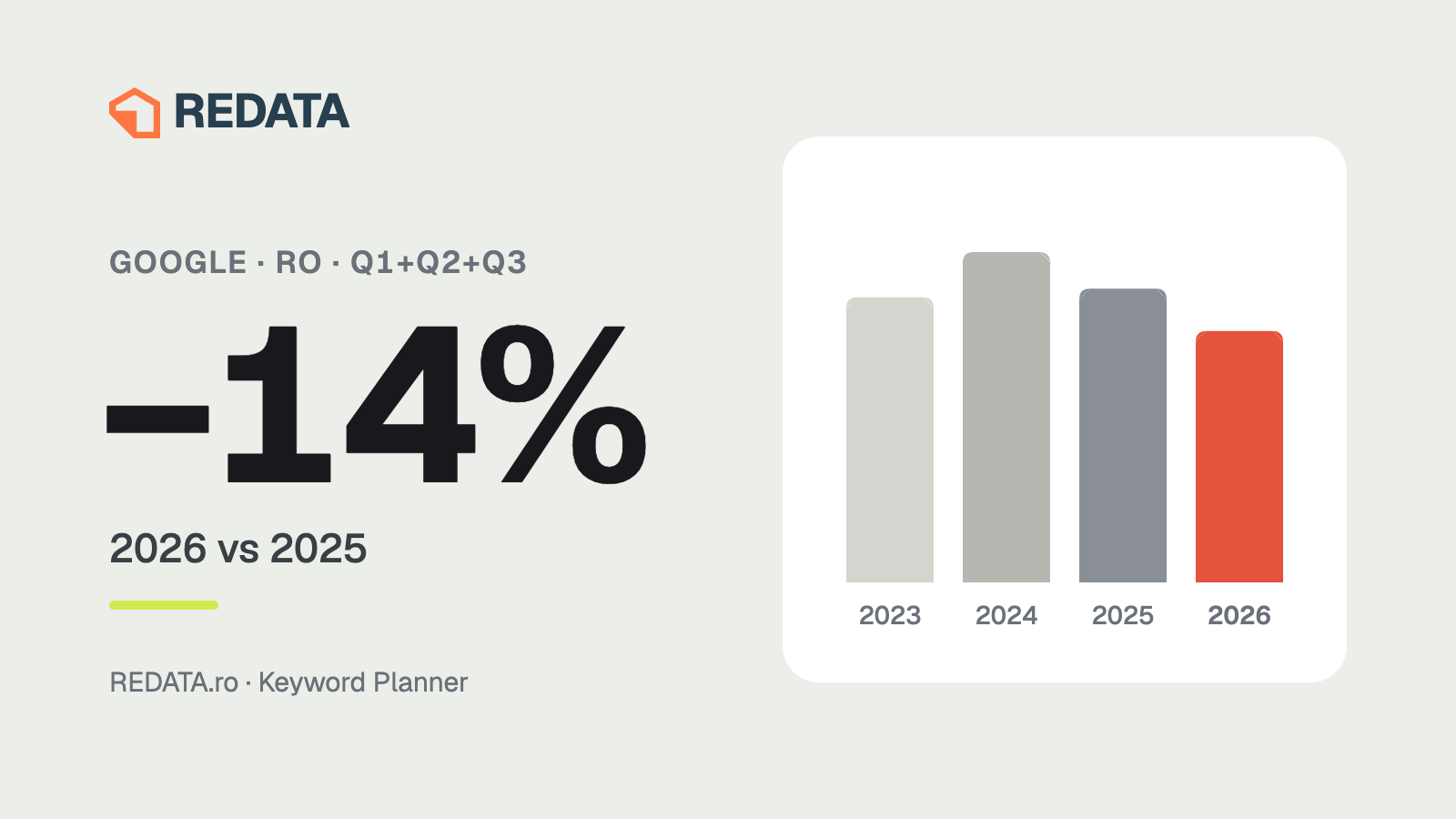
In the first nine months of 2026, Google searches for the 2,440 home-related keywords tracked by REDATA.ro fell 14% from the same period of 2025 and 23.9% from 2024. All 43 cities in the panel lost searches. Searches naming a portal held almost level (−2%): more and more people simply type "storia".
The figures come from REDATA.ro, which collects the monthly volumes Google Keyword Planner reports, from October 2022 to September 2026. We always compared the same months across years, so seasonality doesn't distort the comparison.
In short
- The first nine months of 2026 brought 8.4 million searches, 14% below 2025 and 23.9% below 2024. It is the second year of decline in a row, and every month of 2026 was below the same month of 2025.
- 2-room and 3-room apartments lost the most (−24% and −23%). Houses and villas lost the least (−9%), and searches naming a portal held almost level (−2%).
- The market explains a large part of the drop. The data doesn't yet show searches moving to ChatGPT, Claude or Perplexity, but AI use is growing, so some of the volume will probably move to assistants in the coming years.
1. How much did searches for homes fall in 2026?
By 14% in the first nine months, compared with the same period last year: from 9.77 to 8.36 million searches. The drop held all year, at −17.0% in the first quarter, −11.1% in the second and −14.6% in the third.
The peak was 2024, with 10.99 million searches in the same nine months. Since the second quarter of 2025, every quarter has lost at least 11% year on year, and 2026 has now fallen below 2023 as well.
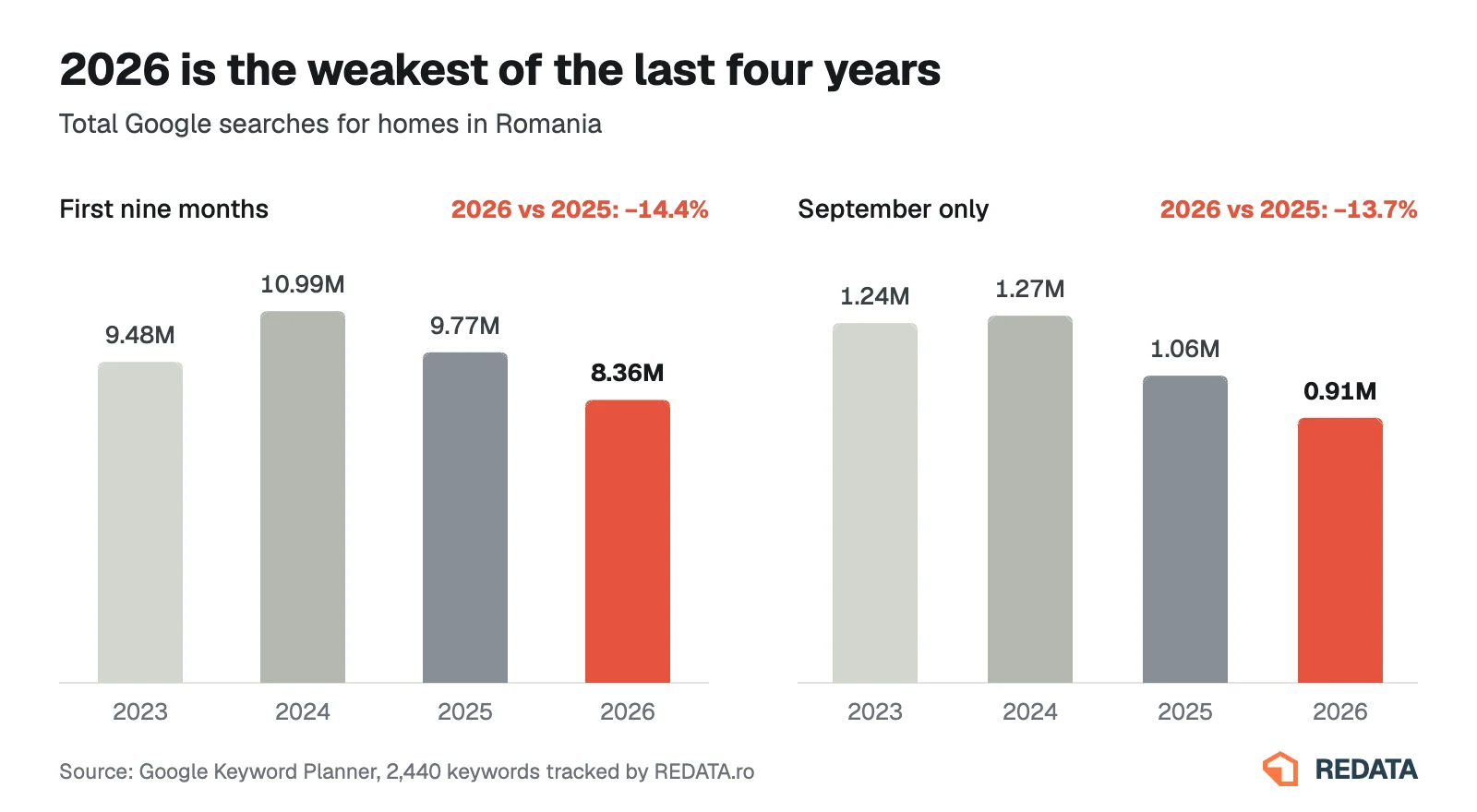
- 2023: 9.48 million searches in the first nine months.
- 2024: 10.99 million (+15.8%).
- 2025: 9.77 million (−11.1%).
- 2026: 8.36 million (−14.4%).
2. How did September 2026 compare with earlier years?
Like the rest of the year: 913,800 searches, 13.7% below September 2025, practically the same pace as the nine-month average. September confirmed the trend; it didn't deepen it.
What changed is the calendar. In 2023, September was the peak month of the first nine, and since 2024 the peak has been January.
- 2023: the peak was September, 17.7% above the monthly average of the first nine months.
- 2024: the peak moved to January (+15.2%), and September was 3.7% above average.
- 2025: January was 23.7% above average, September 2.4% below.
- 2026: January was 16.0% above average, September 1.6% below.
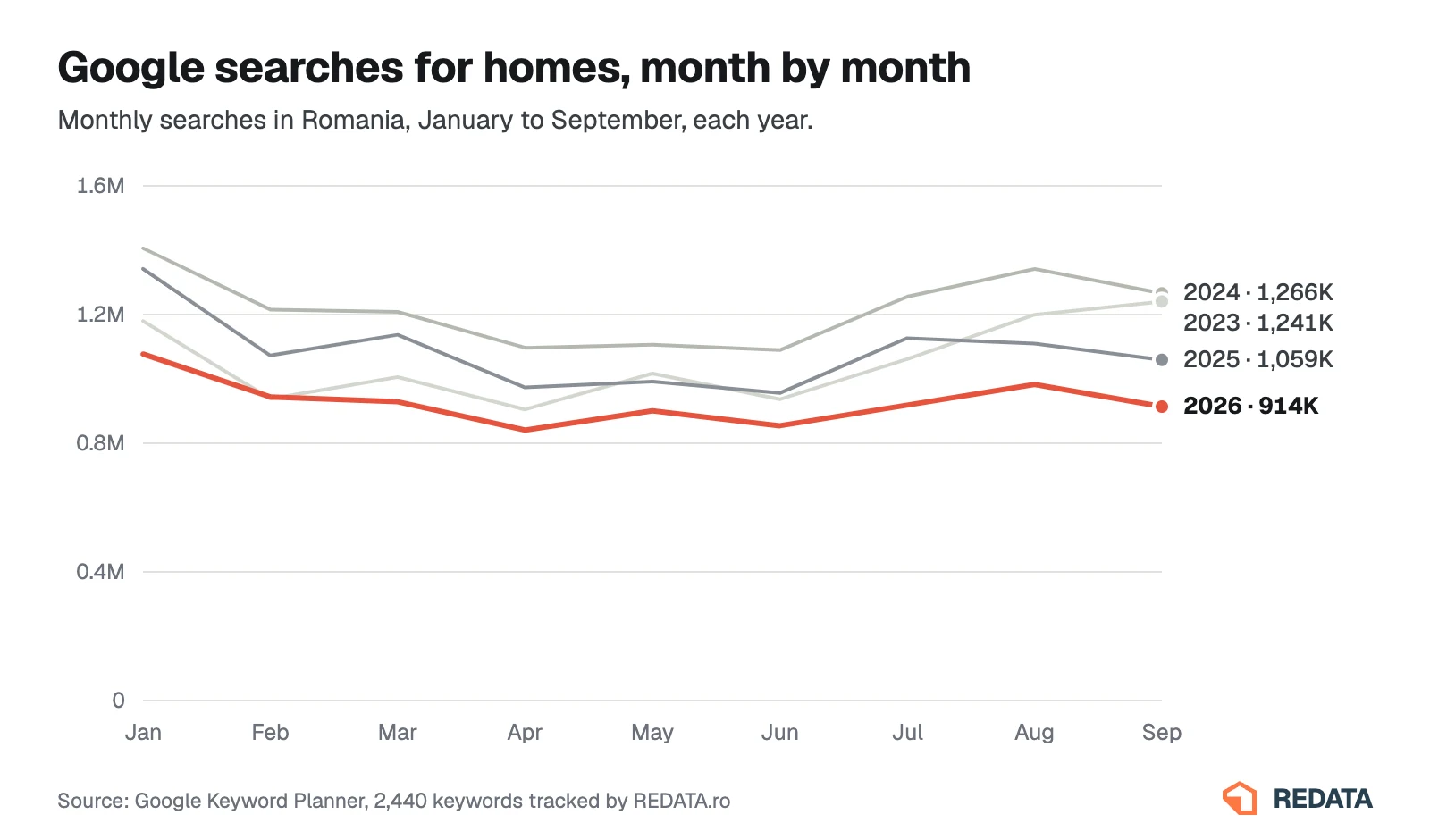
KEY TAKEAWAY: Since 2024, the month with the most home searches has been January, not September. An autumn budget built on the 2023 pattern assumes a peak that no longer comes.
3. Which cities saw the steepest drop in searches?
Among the cities with the most tracked searches, Craiova (−22.3%), Oradea (−20.5%) and Pitești (−20.3%). Cluj-Napoca lost the least, 8.1%: after a weak first quarter (−16.8%), the decline almost stopped, at −3% in the second and third quarters.
The decline is general. All 43 cities in the panel had fewer searches than in 2025, and Bucharest, with 1.8 million searches in nine months, lost 16.5%.
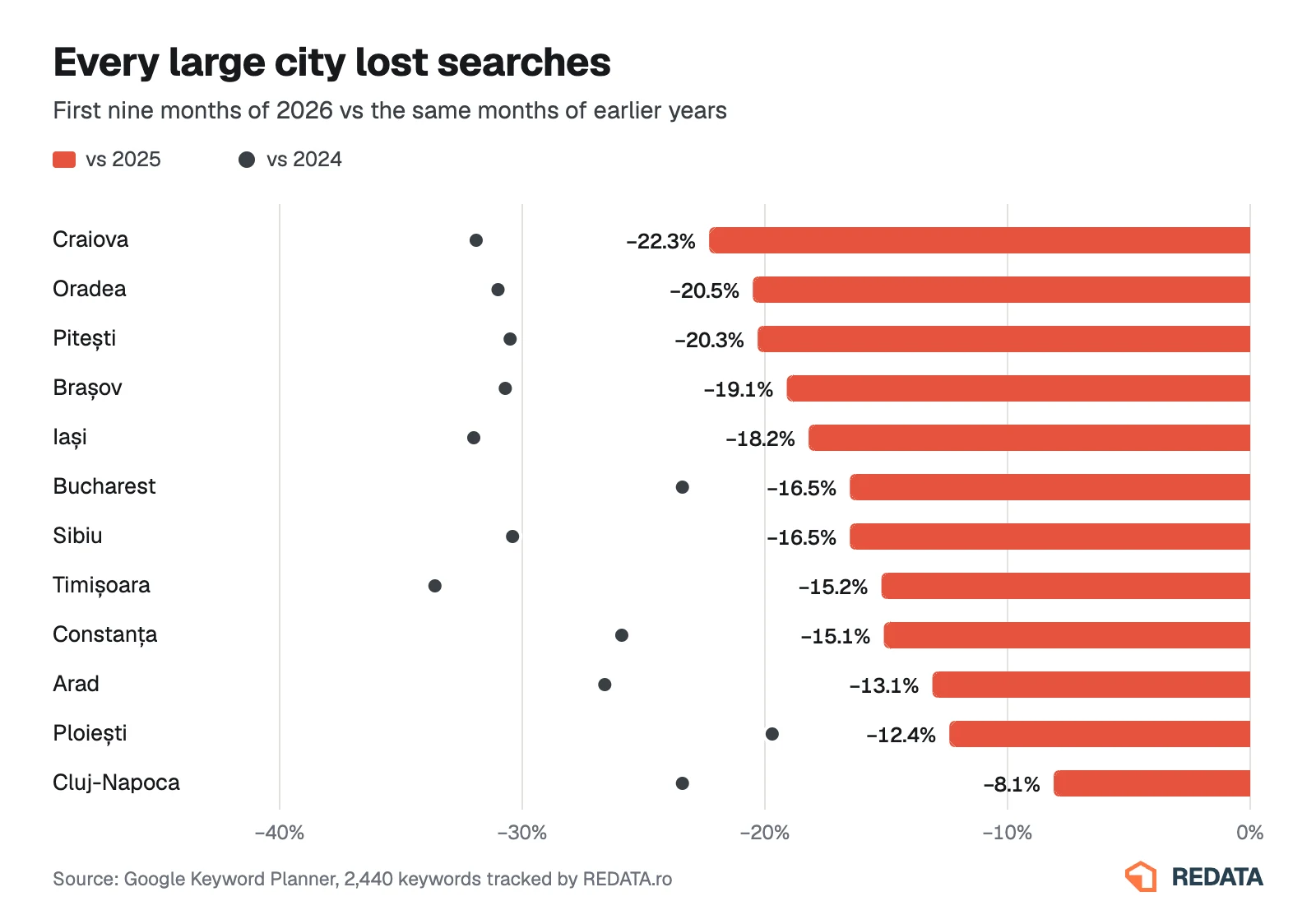
| City | Searches, first 9 months of 2026 | vs 2025 | vs 2024 | September vs 2025 |
|---|---|---|---|---|
| Bucharest | 1,801,625 | −16.5% | −23.4% | −12.8% |
| Timișoara | 557,460 | −15.2% | −33.6% | −16.1% |
| Brașov | 494,300 | −19.1% | −30.7% | −18.3% |
| Constanța | 475,790 | −15.1% | −25.9% | −10.4% |
| Iași | 360,580 | −18.2% | −32.0% | −21.5% |
| Sibiu | 272,440 | −16.5% | −30.4% | −20.2% |
| Craiova | 230,690 | −22.3% | −31.9% | −12.1% |
| Cluj-Napoca | 215,930 | −8.1% | −23.4% | −2.0% |
| Oradea | 193,140 | −20.5% | −31.0% | −25.8% |
| Ploiești | 190,860 | −12.4% | −19.7% | −12.1% |
| Pitești | 155,850 | −20.3% | −30.5% | −23.5% |
| Arad | 152,760 | −13.1% | −26.6% | +1.6% |
Compare each city with its own past, not cities with each other. The panel has 763 keywords for Bucharest and only between 39 and 43 for Oradea, Craiova or Arad, and in these cities the three largest keywords make up about half of the volume.
4. Which types of homes are searched less?
2-room apartments (−24.4%) and 3-room apartments (−23.1%), exactly the homes first-time buyers usually look for. Houses and villas lost the least, 9.4%.
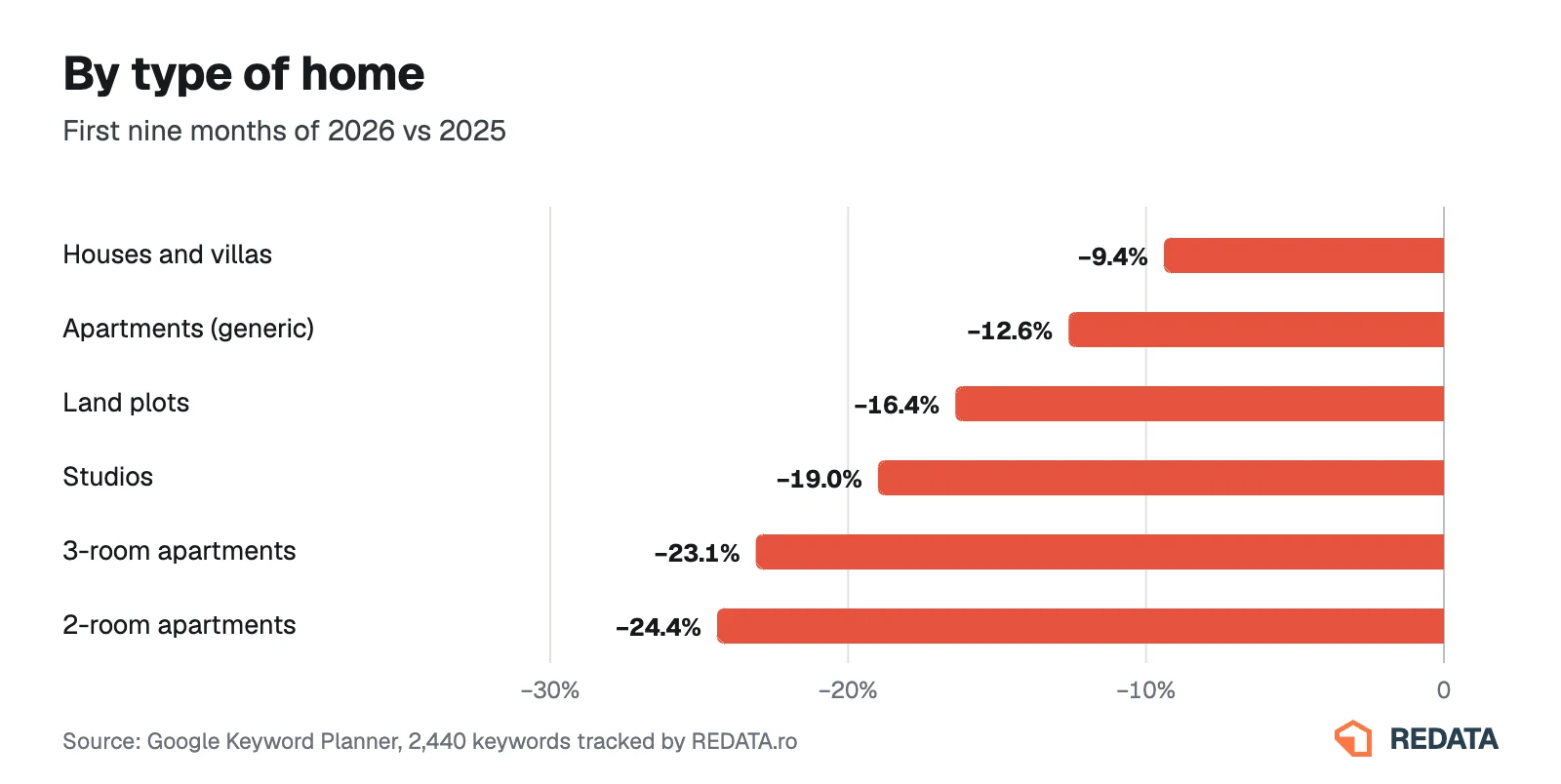
- Studios: −19.0%.
- Land plots: −16.4%.
- Searches to buy: −14.2%. Searches to rent: −14.3%.
Renting didn't gain ground in searches, even though rents rose 39.5% in a year, according to the consumer price index INS published for September 2026. Rentals' share of sale-and-rent searches stayed at 23% in both 2025 and 2026.
5. Why are searches falling: the market or habits?
A large part of it is the market, though search data can't say exactly how much. The decline deepened in the second half of 2025 (from −9.1% to −14.0% year on year), right after VAT on new homes rose from 9% to 21% on 1 August 2025.
That same summer, consumer confidence fell from between −9 and −18 in 2024 to −32, according to the European Commission survey published by Eurostat, and stayed there through September 2026. Real wages have fallen for 14 months in a row (INS), and home prices rose 12.1% year on year in the second quarter of 2026 (Eurostat).
- Sales fell less than searches. ANCPI recorded 272,657 properties sold in the first half of 2026, 5.6% fewer than in 2025, and June was above June 2025.
- That gap is normal for this kind of data. In 2024, searches rose 10.3% while ANCPI sales rose 1.3%, and in 2025 searches fell 11.5% while sales fell 2.3%.
- Buying plans didn't change. The stated intention to buy or build a home in the next 12 months stayed at the same level in the same survey, and banks told the National Bank of Romania that demand for housing loans rose strongly in the second quarter of 2026.
- More homes are being built in Bucharest-Ilfov. The region completed 6,946 homes in the second quarter of 2026, more than twice as many as a year earlier (3,201), according to INS. About two thirds of the homes completed there in 2025 were built by companies. Nationally, almost three quarters (72%) are financed by households, mostly people building their own houses.
KEY TAKEAWAY: Searches are falling faster than sales. In the first half of 2026, tracked searches fell 14.3% and properties sold, as registered by ANCPI, fell 5.6%. When they fall, casual browsers probably leave first, and the people still searching seem to be more committed buyers. For marketing, that means fewer leads, probably more serious ones.
6. Have Romanians moved from Google to ChatGPT, Claude or Perplexity?
Not yet to an extent we can see in the data. The decline started at the end of 2024 (November 2024 already had 10% fewer searches than November 2023) and didn't steepen after 8 October 2025, when Google launched AI Mode in Romanian.
The pattern doesn't look like a move to assistants either. Long searches, of five words or more, fell about as much as short ones (−14.7% vs −13.5%), and mortgage calculators and simulations lost 13.3%, about as much as the market.
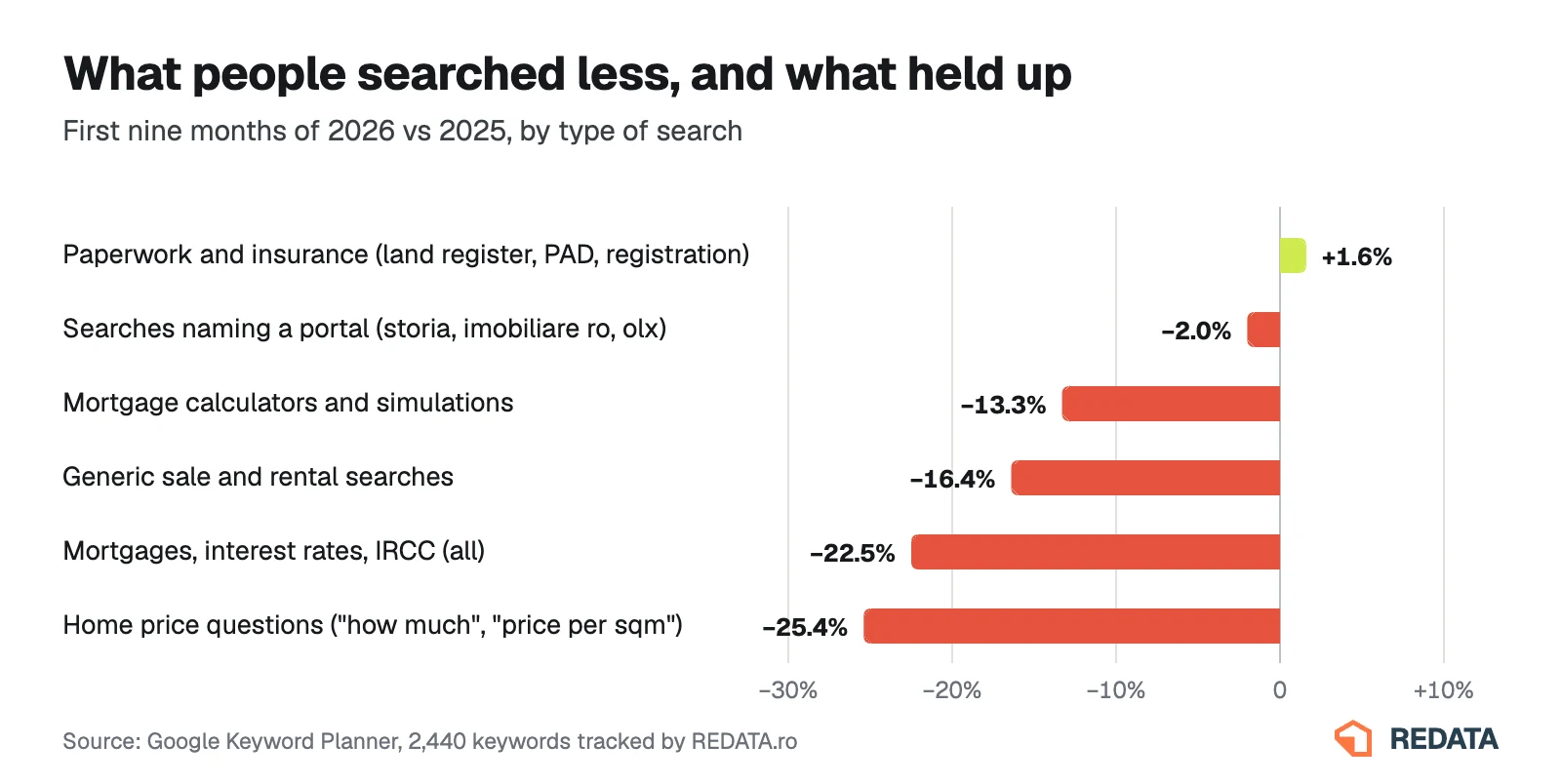
Questions about home prices ("how much is an apartment in Iași", "price per square metre") fell 25.4%, more than the market. The base is small, though, about 12,400 searches in nine months, so we draw no conclusion about AI from it.
The shift is coming; Romania just starts from a low base. Eurostat shows that in 2025 only 17.8% of Romanians aged 16 to 74 used generative AI tools, the lowest share in the EU, where the average is 32.7%.
- Use is growing: Microsoft estimates that the share of working-age Romanians using generative AI rose from 15.3% in the first half of 2025 to 17.5% in the first quarter of 2026.
- Among urban internet users, 68% already use AI in their daily lives, and 83% of them use it to look up information, according to Reveal Marketing Research (January 2026).
- Google remains almost the only search engine: 96.3% of visits coming from search engines in Romania, according to StatCounter.
The AI effect you can already see is different: fewer clicks, not fewer searches. A 2025 Pew Research Center study in the US found that users click a traditional result in 8% of visits when Google shows an AI summary, against 15% without one.
KEY TAKEAWAY: The 2026 data doesn't show searches moving from Google to ChatGPT, Claude or Perplexity. With AI use at a little over half the European average and rising, it is realistic to expect some of the volume to leave in the coming years.
7. What did people search for more in 2026?
Paperwork and mandatory insurance. Searches about documents and home insurance (land register extracts, PAD insurance, property registration, energy certificates) grew 1.6%, and "asigurare locuință obligatorie" (mandatory home insurance) nearly doubled, from 5,150 to 10,080 searches.
Searches that contain the year show what worried owners and buyers. "Impozit apartament 2026" (apartment tax 2026) had 49,500 searches in January alone, after Law 239/2025 raised the taxable value of homes with all utilities from 1,567 to 2,677 lei per square metre. "TVA locuințe 2026" (VAT on homes 2026) peaked in July, the month the 9% transitional regime was due to expire (the deadline was later extended to 30 September).
- Searches that contain the year (for example "impozit apartament 2026"): 80,940 in the first nine months of 2026. Their "2025" versions aren't in the panel, so we don't compare them with last year.
- "Chirii Cluj-Napoca" (Cluj-Napoca rentals): +12.8%, while "chirii București" stayed almost level (+1.7%).
8. What does it mean for positioning and brand?
That demand for a known name holds up when generic demand falls. Searches naming a portal lost only 2%, and their share of all tracked searches rose from 10.4% in 2023 to 16% in 2026.
The gain isn't shared equally. Searches for "storia" grew 7.8% from 2025 and 42% from 2024, while imobiliare.ro lost 4.7%, OLX 8.2% and the smaller portals 32.1%.
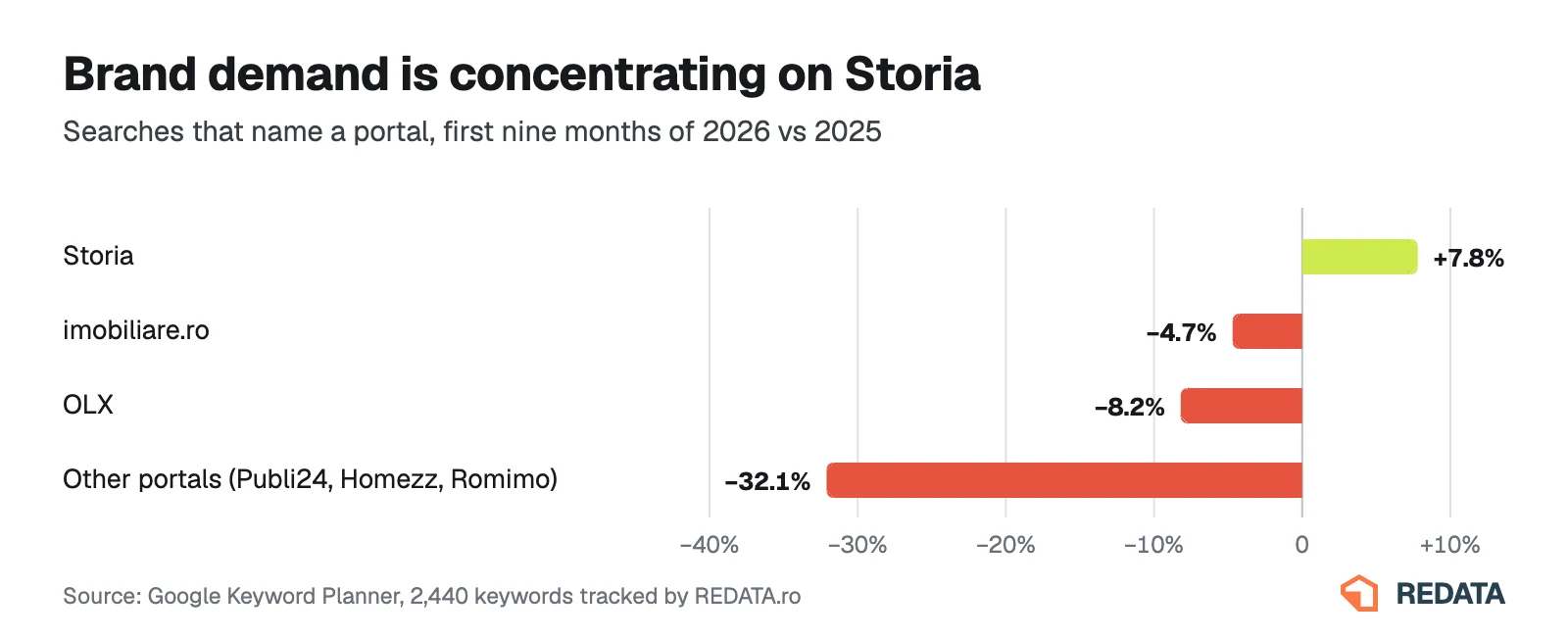
A generic search is demand you share with the whole market; a search for your name is demand you built yourself. For a developer, "your name" means the name of the project and of the company.
- Choose a project name that is easy to type and search, and that can't be confused with other developments in the city.
- Track how many searches the project name gets each month. When generic demand falls, it is the most honest indicator of awareness.
- Keep complete listings on the portal people search for: floor plans, prices, real photos. A growing share of the people still searching on Google type the portal's name directly.
9. How did we work with the data?
We used the 2,440 keywords in the REDATA.ro panel that have Google Keyword Planner volumes for Romania, from October 2022 to September 2026. The volumes are Google's rounded estimates, and close variants (for example "apartament iasi" and "apartamente iasi") get the same volume, so we counted them once.
- We left searches that contain the year ("impozit apartament 2026") out of the comparisons, because their last-year version doesn't exist in the panel. We analysed them separately; with them included, the nine-month drop would be 13.6% instead of 14.4%.
- We corrected the city for 16 keywords that had been assigned to the wrong one.
- We corrected one error in Google's February 2026 data. For 20 apartment keywords in 11 cities, Keyword Planner reports 23 to 660 times the usual number of searches in February 2026, and the old level again from March. Fifteen of them are searches for new apartments or residential complexes. One example: "apartamente noi bartolomeu" gets about 10 searches a month and 6,600 in February 2026. The jumps are identical in two separate Keyword Planner exports, one with data to August and one to September 2026, and Google's own monthly average includes them. This does not look like real demand: the other searches for the same neighbourhoods and cities stayed at their usual level in February, and 20 unrelated searches are unlikely to jump tens or hundreds of times in the same month and fall straight back. We replaced each of the 20 values with the keyword's median month between January 2025 and September 2026. The correction removes 42,770 searches, 0.5% of the first nine months of 2026, and moves the national change from −14.0% to −14.4%. Using the mean of January and March 2026 instead of the median gives the same percentages.
- ANCPI data stops in June 2026, after the July cyberattack, so July, August and September sales are not yet known.
Frequently asked questions
Did searches for apartments fall in 2026?
Yes. In the first nine months of 2026, searches for homes fell 14% from 2025, and searches for 2-room and 3-room apartments fell 24% and 23%.
How do real estate searches by city look in 2026?
All 43 tracked cities lost searches. Among the 12 cities with the most tracked searches, Craiova, Oradea and Pitești lost more than 20%, and Cluj-Napoca the least, 8.1%.
Does the drop in searches mean sales are falling too?
Not by the same amount. In the first half of 2026, tracked searches fell 14.3% and properties sold, as registered by ANCPI, fell 5.6%. In 2024 and 2025, too, searches moved more than sales.
Do Romanians use ChatGPT instead of Google for real estate?
The 2026 data doesn't show it yet. Only 17.8% of Romanians used generative AI in 2025, the lowest in the EU, but the share is growing, so some searches will probably move to assistants in the coming years.
What was different about September 2026 in the property market?
September 2026 had 13.7% fewer searches than September 2025, about the same as the year's average. Since 2024, September is no longer the peak month for searches; the peak has moved to January.
Conclusions
- Google searches for homes fell for the second year in a row: 8.36 million in the first nine months of 2026, 14% below 2025 and 23.9% below the 2024 peak. All 43 cities in the panel lost searches.
- The year's peak has moved. Since 2024, January has had the most searches, and in 2025 and 2026 September was below the monthly average.
- 2-room and 3-room apartments fell the most (−24% and −23%), houses and villas the least (−9%). Among the 12 cities with the most searches, the drop ranges from 8.1% in Cluj-Napoca to 22.3% in Craiova.
- Searches move more than sales. In the first half of 2026, searches fell 14.3% and sales registered by ANCPI fell 5.6%.
- The data doesn't yet show a shift to ChatGPT, Claude or Perplexity: long searches fell about as much as short ones. Searches naming a portal held almost level (−2%), and their share rose from 10.4% in 2023 to 16% in 2026.