
Romania's residential property market in review: a full analysis of the 2023–2025 cycle and the strategic outlook for 2026

Contents
Executive summary
Between 2023 and 2025, Romania's residential property market went through one of the most complex and eventful periods in its recent history, and it proved highly resilient to a build-up of economic and legislative pressures. In a climate of persistent inflation, high financing costs and frequent, hard-to-predict tax changes, the sector avoided a severe contraction and even set new all-time highs for transaction prices and sales volumes in certain windows of opportunity.
This review sets out to give a complete, data-based picture of how the market evolved. It takes apart the mechanisms behind the price increases, looks at the impact of tax policy (especially the successive VAT changes) and offers a reasoned view of what 2026 holds. Beyond what happened, we look at why it happened and how these events will shape the future of housing in Romania. The report covers every part of the property market, including Cluj's continued lead in the price rankings, Brașov's revival and the complexity of the Bucharest market.
Chapter 1: The macroeconomic context and market fundamentals (2023–2025)
To understand how property evolved, we first have to look at the macroeconomic picture behind the transactions. The 2023–2025 period was far from linear: it brought one shock after another, and Romanian consumers kept adapting to a new economic reality.
1.1. Inflation and purchasing power: a strained relationship
Inflation was the main macroeconomic force of the period. After the alarming peaks of 2022, when the inflation rate hit 13.8%, the following years brought a gradual easing, but the cost of living stayed high. In 2023 inflation fell towards 10.4%, in 2024 it reached 5.3%, and by the end of 2025 the consumer price index stood at around 5.1%.
This had a double effect on the property market. On one hand, inflation eroded the purchasing power of disposable income and made saving for a deposit much harder for middle-income households. On the other, it acted as a strong catalyst for investment. Romanians, who have long treated property as a store of wealth, saw buying real estate as the only workable way to protect their savings from the falling value of money. This "safe haven" mindset kept demand up even as affordability indicators got worse.
IMF and European Commission forecasts for 2025 and 2026 put Romania's economic growth between 2.5% and 3.7%. That suggests a moderate pace, but no recession, which gives housing demand a solid base.
1.2. Consumer confidence: between caution and opportunity
Consumer confidence swung widely. Colliers reports show that Romania entered a "moderation" phase in 2025, with a sharp fall in consumer confidence, the steepest in the last 15 years apart from the pandemic shock. Political uncertainty, endless debates about tax changes and a slowing labour market drove this drop in sentiment.
Even so, what buyers did often contradicted what they told pollsters. Pessimistic on paper, they acted pragmatically. When the law opened a window of opportunity (as it did before the VAT increase), the market reacted explosively. This shows that the need for housing and the appetite for investment outweighed the general sense of uncertainty.
Chapter 2: The cost of money and lending
The property market cannot be separated from the credit market. In 2023–2025, interest rates tested how much borrowers could bear, and that changed the structure of transactions.
2.1. Reference rates: IRCC and ROBOR
The move from cheap money to interest rates that settled at high levels was brutal. In 2021 the indices were below 2%; at the end of 2025 we are in a completely different world.
The data shows IRCC settling between 5.68% and 6.06% over 2024–2025, while ROBOR 3M hovered around 6.03%–6.14% at the end of the year.
Add the bank's fixed margin (usually between 2% and 2.5%) to these indices and new loans ended up at 8–9% interest. At that cost, households could borrow far less. Monthly payments rose by 50–70% compared with 2021 simulations for the same loan amount, which pushed a large group of marginal buyers out of the market.
2.2. The impact on the structure of transactions
The direct consequence of high interest rates was a change in the buyer profile. The market came to be dominated by:
- Cash buyers: people with money on hand, who bought to protect it from inflation.
- Buyers with a large deposit: they take out small top-up loans and are less sensitive to changes in interest rates.
- Professional investors: they weigh yields against the cost of capital.
Despite the costs, lending did not freeze. Data from the National Bank of Romania (BNR) shows that the stock of housing loans reached RON 110.2 billion at the end of 2024, up 4.2% on the previous year. The share of loans in RON reached 88.8%: currency risk has left household balance sheets, but interest rate risk has taken its place.
2.3. The Noua Casă programme
The "Noua Casă" (New Home) programme lost much of its effect. The guarantee ceiling stayed the same while home prices rose. On top of that, the VAT increase hit the programme's target group directly: young people buying their first home, who are the most sensitive to price. Final prices went up because of VAT while the loan ceiling stayed fixed, so buyers had to cover the difference from their own pockets, and for many that was impossible.
Chapter 3: The tax and legal shock, with VAT as the deciding factor
Inflation and interest rates were market forces. The tax changes were outside shocks that artificially distorted supply and demand. The VAT "saga" was, without doubt, the most debated topic of 2024–2025.
3.1. A timeline of tax instability
To understand why the market was so nervous, look at how quickly the changes followed one another:
- Background: the market was used to a reduced 5% VAT rate for homes under 120 m² and below a ceiling of about €120,000. This gave a big boost to the mass-market segment.
- First shock (2024): the reduced rate went up to 9%. The market absorbed the cost, although it cut margins and affordability.
- Second shock (2025): a new law raised it again, scrapping the 9% rate for most categories and applying the standard rate (19% or 21%, according to the latest tax talks) from 1 August 2025.
3.2. The "July 2025" effect
The announcement that VAT would rise substantially from 1 August 2025 (an effective price increase of at least 10–12 percentage points for the end buyer) set off a buying frenzy. Buyers with signed pre-contracts, and those who had been hesitating, rushed their purchases to catch the "last train" of reduced taxes.
The effect showed up in the statistics at once. July 2025 became a record month, with transactions up almost 17% nationwide and peaks above 30% in counties such as Constanța. Developers worked flat out to finish the paperwork, and notary offices were overwhelmed.
Pulling demand forward like this had a flip side, though: the following months (September–October 2025) brought a natural drop in volumes, as the market entered a period of calm and readjustment.
3.3. How developers reacted
The legal instability forced developers into drastic defensive moves. The law firm Elisabeta Stan Law Office notes that developers began writing much stricter contract clauses, adjusting delivery dates and restructuring their companies (holdings) to optimise taxes. Worse, the lack of predictability stalled the launch of new projects: developers preferred to wait for legal clarity rather than risk building a product that the final taxes would make unsellable.
Chapter 4: Prices on an upward spiral
Contrary to the gloomy forecasts, prices did not fall. Quite the opposite: in 2024 and 2025 price growth sped up, driven by construction costs, the VAT increase and, paradoxically, the drop in new supply.
4.1. The national picture
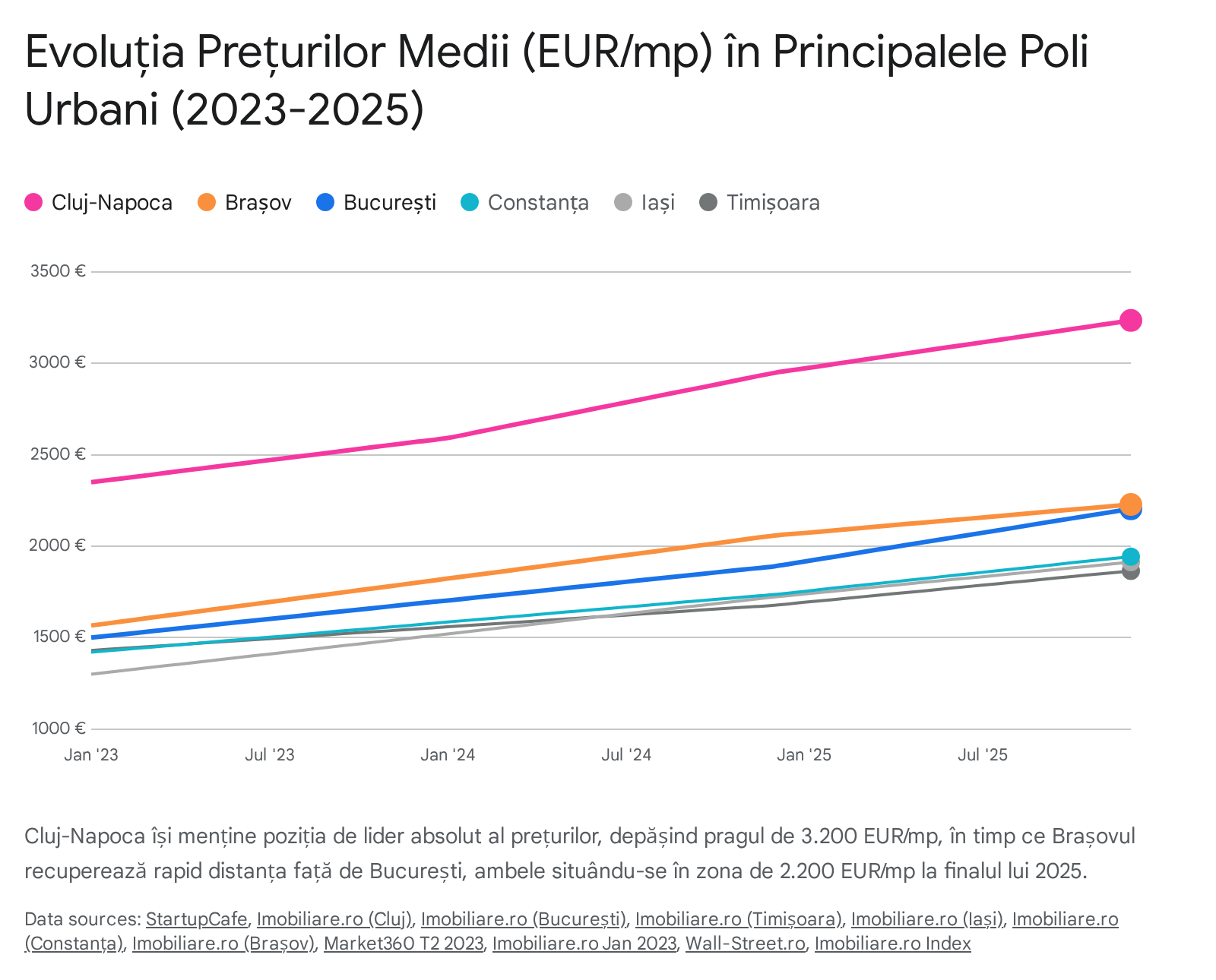
Nationally, the average asking price for apartments listed for sale reached €1,965/m² in December 2025, a sizeable annual increase of 13.8% compared with December 2024. That average hides huge regional gaps and a sharp divide between the big economic centres and the rest of the country.
4.2. Cluj-Napoca: the undisputed leader
Cluj-Napoca remains a special case in the Romanian housing market: prices keep rising despite the economic conditions.
- December 2025 price: €3,235/m².
- Change: up 9.7% on the previous year.
- The "convergence" effect: one striking detail is how far the price gap between new apartments (€3,303/m²) and old ones (€3,227/m²) has narrowed. At times the difference was just €14/m². That points to an acute supply shortage: buyers will pay "new" prices for old apartments just to get a central location, because there are no modern alternatives in those areas. The city is a victim of its own economic success (as an IT hub) and of its geographic and planning limits.
4.3. Bucharest: the giant wakes up
After a period of moderate growth, Bucharest accelerated hard in 2025, narrowing its historical gap.
- December 2025 price: €2,204/m².
- Acceleration: up 16.6% on December 2024, one of the highest growth rates among the big cities.
- Extreme segmentation: Bucharest is the city of the sharpest contrasts.
- Luxury: the Aviatorilor, Primăverii and Kiseleff areas reached €4,500–4,900/m². They work as a completely separate market, immune to interest rates and backed by the capital of big entrepreneurs.
- Mass market: the commuter neighbourhoods (Militari, Drumul Taberei) still drive the volume, but here too prices for new units have jumped past the psychological threshold of €2,000/m².
- Outskirts: areas such as Ferentari stay at about €1,100–1,300/m², the only "islands" of low prices left in the capital.
Bucharest's faster growth is partly a catch-up effect, and also the direct result of the administrative deadlock in urban planning (the suspended sector zoning plans, or PUZs). With permits so unpredictable, the future stock (the pipeline) has shrunk, which puts pressure on the prices of the existing stock.
4.4. Brașov: a meteoric rise
Brașov was, without doubt, the surprise "star" of the last property cycle.
- December 2025 price: €2,228/m².
- Performance: at times it has overtaken the Bucharest average, quite a feat for a provincial city. Between 2019 and 2025 prices doubled, the largest long-term percentage increase in the country.
- Drivers: Brașov-Ghimbav International Airport changed the equation, making the city an easy destination for weekend tourism and second-home investment. Drumul Poienii has become one of the most exclusive areas outside the capital, with prices above €3,000/m².
4.5. Other regional markets
- Constanța (€1,943/m², +11.9%): still a strong seasonal market, but a volatile one. Its premium areas (Faleza Nord) compete with prices in the capital.
- Iași (€1,913/m², +11.1%): the capital of Romania's Moldavia region is catching up fast. Growth in IT and in office complexes (Palas) has created a class of creditworthy buyers who pushed prices up, although the city's overall average is still below €2,000/m².
- Timișoara (€1,865/m², +11.2%): economically very strong, Timișoara has historically seen slower property price growth, but it sped up in 2025 on demand for new homes.
- Craiova: recorded spectacular increases, close to 19–21% in some reports, leaving stagnation behind and becoming an important regional growth hub.
Chapter 5: Supply and construction in a structural slowdown
While demand and prices stayed strong, the supply of new homes started to show serious signs of fatigue. The cause is red tape and costs; developers have not lost interest.
5.1. Fewer completions and permits
Figures from the National Institute of Statistics (INS) are alarming for the future housing stock:
- 2024 completions: the number of finished homes fell 15% on the previous year, to just 60,787 units. That is more than 10,000 fewer homes reaching the market.
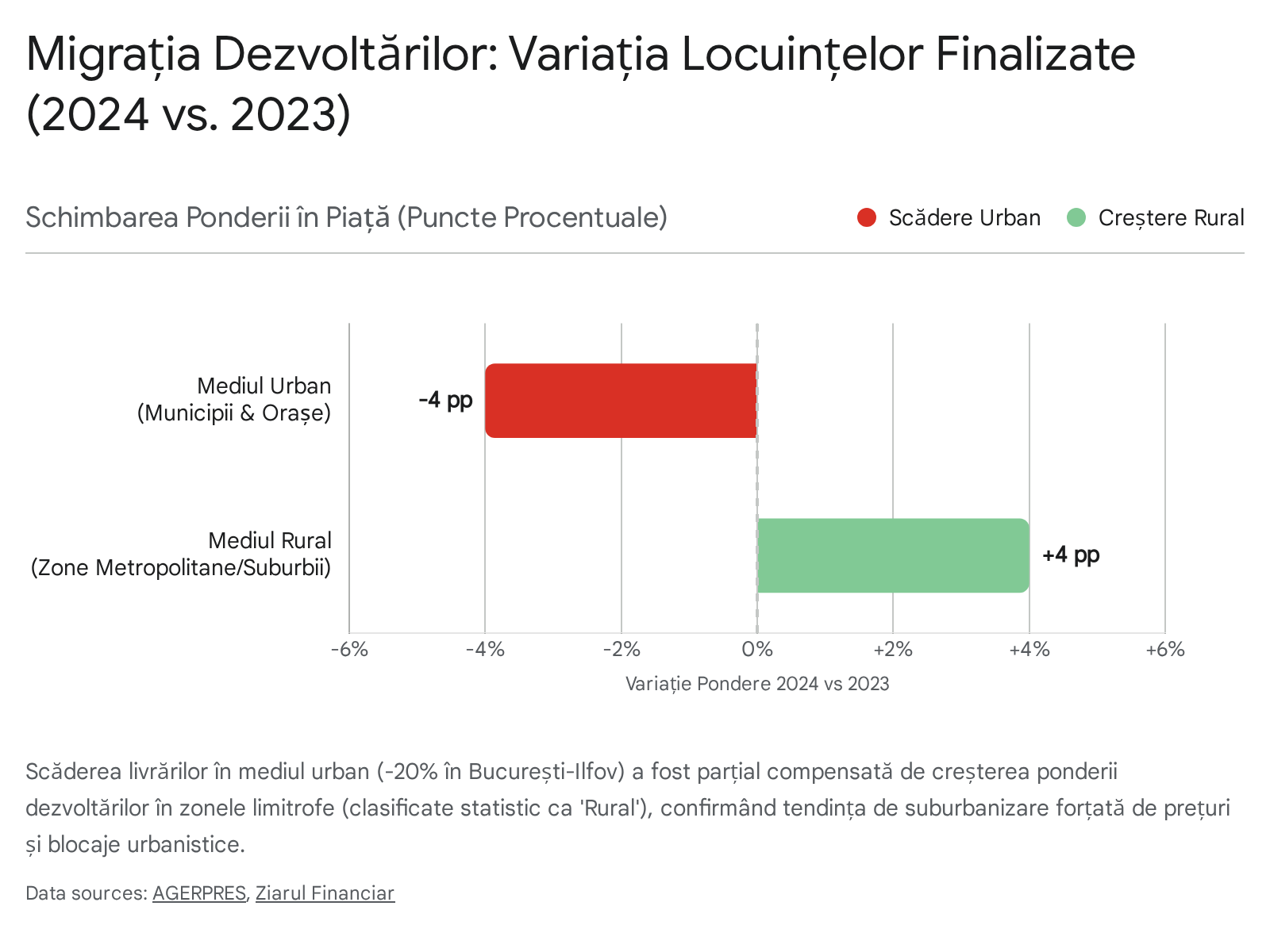
- Collapse in the capital: in the Bucharest-Ilfov region the drop was even steeper, at 20%. That is a massive contraction for the country's largest and most active market, and it partly explains the huge pressure on prices.
- Permits: the first 8 months of 2025 showed a slight rise in the number of permits (+4.4%), but the volume is still below what is needed to replace the stock sold. On top of that, many permits are issued on the outskirts, not in the central areas where demand is highest.
5.2. The move to the outskirts (suburbanisation)
One basic trend in the statistics is the changing geography of new developments.
- The share of homes completed in "rural" areas rose from 39% to 43% in 2024, at the expense of urban areas.
- This statistical label is misleading. The "rural" in INS data means the communes next to the big cities (Florești near Cluj, Giroc/Dumbrăvița near Timișoara, Miroslava near Iași, Popești-Leordeni/Chiajna near Bucharest), not isolated villages.
- The cause: planning deadlocks in the big cities and the prohibitive cost of land pushed developers towards these commuter areas, where permits are easier to get and land is cheaper. In the long run, though, this creates major infrastructure and traffic problems.
Chapter 6: The rental market as the fallback option
As prices, the VAT rise and interest rates made buying a home ever more expensive, the pressure moved to the rental market. Renting became the safety valve of the housing system.
6.1. Prices and yields
Rents rose steadily in 2024 and 2025, as landlords tried to pass the costs of inflation and taxes on to tenants.
- Cluj-Napoca: still the most expensive city for tenants, with averages of €400–420 for a studio and €550–600 for a two-room apartment.
- Bucharest: huge variation. In Sector 1 the average rent can reach €799, while the overall average for a two-room apartment is around €550–600. The most affordable rents are in Sectors 4 and 6.
- Yields: Romania remains an attractive market for buy-to-let investors. The average gross yield is between 6% and 6.55%.
- Yields show a paradox. In luxury areas (e.g. Primăverii) they are lower (3–4%) because of the huge purchase price, and investors there are betting on the asset gaining value. In working-class neighbourhoods (e.g. Militari, Drumul Taberei), yields can be 2–4 percentage points higher, because rents are decent compared with a much lower purchase price.
6.2. Buying vs. renting intentions
Surveys from 2025 show an interesting psychological pattern. Although rents are expensive, the intention to buy has come back strongly. 59% of respondents in a major survey said they intended to buy, compared with just 37% in 2023. This suggests that Romanians have accepted the new prices as "the new normal" and would rather take on the financial effort of a mortgage payment in exchange for the stability of ownership, seeing property as the only real long-term protection.
Chapter 7: 2026, a year of recalibration and maturity
Looking ahead to 2026, the picture taking shape is one of stabilisation, but at a high level of costs. The era of "cheap money" and "cheap apartments" is over for good.
7.1. Pressure points for 2026
2026 will bring its own challenges:
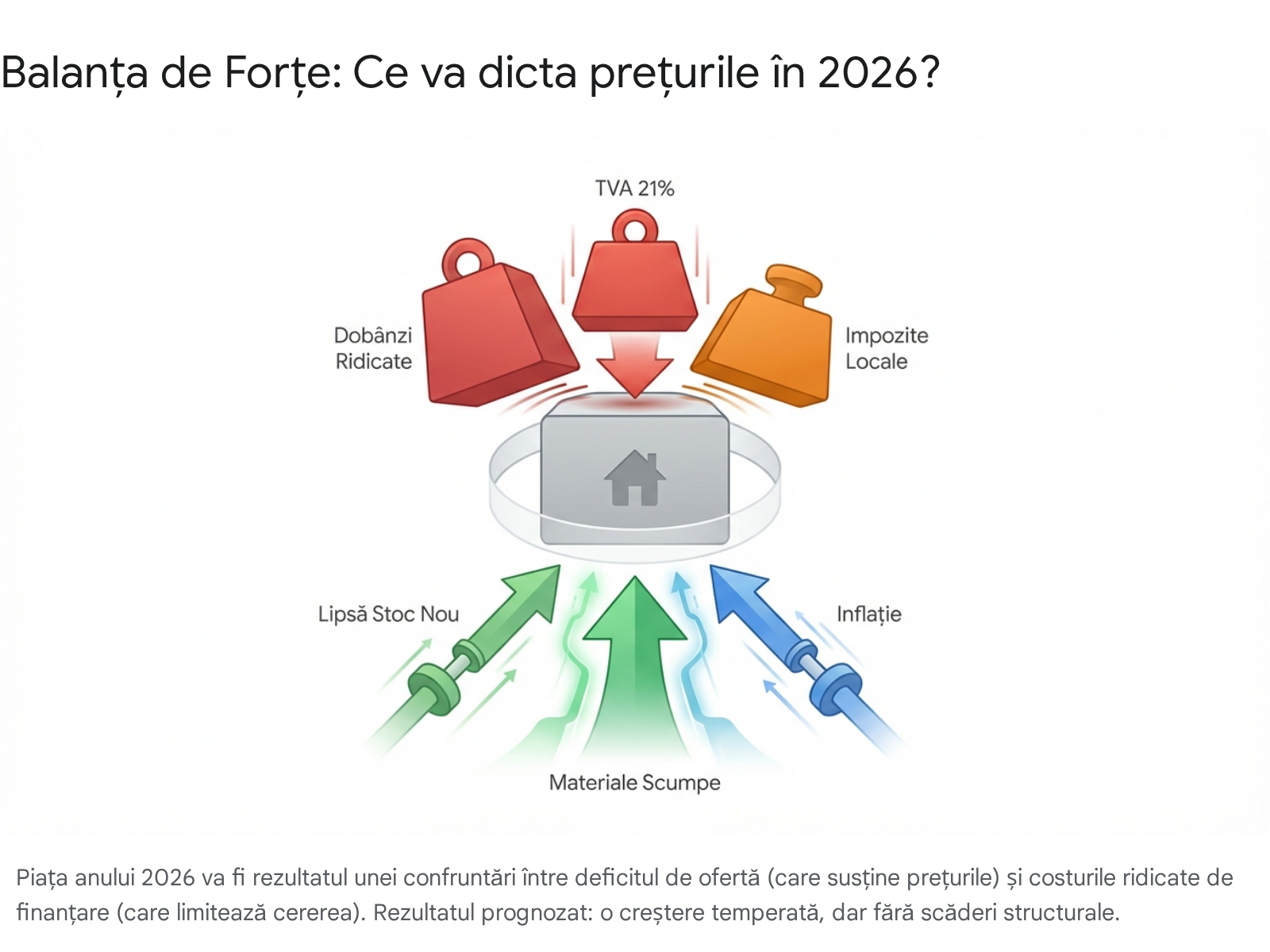
- Tax at market value: from 1 January 2026, the new property tax system is expected to take effect, based on the notaries' price grids (market values) rather than historical or book values. This will raise the yearly cost of owning a property, especially for owners of old apartments in central areas.
- Green costs: carbon taxes (CBAM) on building materials imported from outside the EU (cement, steel) will put extra pressure on developers' production costs.
- VAT across the board: the VAT increase to 19%/21% will be felt in full, wiping out the last "oases" of reduced prices.
7.2. Forecasts: what analysts expect
The consensus among analysts (Colliers, SVN, The List Estates) is that prices will not collapse.
- Moderate growth: the base case is price growth in line with inflation or slightly above it, but below the runaway 13–16% pace of 2025.
- Natural selection: the market will become very selective. Buyers will look closely at the "total cost of housing" (upkeep, energy) and favour new, energy-efficient buildings (nZEB). Old, uninsulated homes could see price corrections or stagnate, losing ground to new ones.
7.3. Conclusions and strategic recommendations
Looking back at the 2023–2025 cycle, Romania's property market has shown that it is mature and able to absorb shocks.
- For buyers: waiting for prices to fall has proved a losing strategy. In 2026 the focus should be on build quality and energy efficiency, the only things that can protect the value of the asset in the long run.
- For investors: diversification is key. Fast-rising secondary cities (Brașov, Oradea, Craiova) offer more growth potential than saturated markets, where the entry price is already very high.
- For developers: adapting to the new tax and environmental requirements will make the difference between projects that succeed and projects that stall.
2026 looks less like a year of crisis and more like a year of economic realism. The market has recalibrated, and everyone in it, whether buying, selling or developing, has to work with the new price and cost levels.